Self-led design study · Firewall rules · 2026
An AI suggests changes. A person approves them.
I sorted an AI's nine suggested changes into three kinds of decision, so safe ones take one click.
Slow down where a mistake would hurt. Risky changes get a reviewer and an undo.
Go deeper 2 min
A concept for reviewing the firewall changes an AI suggests every week. The company, product and data are made up, built from public information on my Vela Design System.
Software can find unused or risky firewall rules. A person still has to decide, because one wrong change can block traffic people rely on.
Six screens, six edge cases, a clickable prototype of the main path, and a handoff for engineers.
I set the problem, the goals and every decision. AI agents drew, researched and scored from my brief.
- 01An AI suggests firewall changes every week. Who approves them?The moment
- 02The nine suggestions fall into three kinds of decision.The real problem
- 03Quick approval for safe changes. A separate page for risky ones.The decision
- 04The admin sees missing evidence before any button.Missing evidence
- 05A change that could block traffic gets a preview, a reviewer and an undo.The request
- 06A wrong approval can be undone before it causes an outage.Being wrong
- 07I set the problem, the goals and the decisions. AI drew the screens from my brief.How it was made
01The moment
An AI suggests firewall changes every week. Who approves them?
A person still has to say yes, and every step of that check can go wrong.
The admin's week, and where each step goes wrong
- 1 · NoticeNine look like nine equal jobsSo the review gets put off.
- 2 · SortThe risky one gets skimmedBecause the others looked fine.
- 3 · Check"No traffic" read as "unused"While two of four sites sent no logs.
- 4 · DecideAn accept blocks trafficThat nobody expected.
- 5 · Roll outThe monitor is too shortTo catch a job that runs weekly.
- 6 · UndoThe way back is slowOr nobody can say why the rule changed.
Go deeper 1 min
Every Monday the AI suggests rules to disable, narrow or merge.
Why this problem
Rule bases collect rules nothing uses, rules an earlier rule already covers, and rules far broader than the traffic they carry. Firewall guidance asks for specific rules and periodic review (NIST SP 800-41). Finding these can be automated. Deciding can't be handed over. After years on security consoles, it was the next problem I wanted to work on.
The trap
Research on AI-assisted decisions found that an explanation makes people more likely to accept the AI's advice whether or not it's right (Bansal et al., 2021). So the design question isn't how to show nine proposals.
Who it's for
- The network security admin who owns the rule base.
- Not drawn, but designed for: the change approver who signs off, and the auditor who later asks why a rule changed. Both read the change log the admin leaves behind.
These costs are reasoned from the task and public sources. They haven't been observed with admins.
02The real problem
The nine suggestions fall into three kinds of decision.
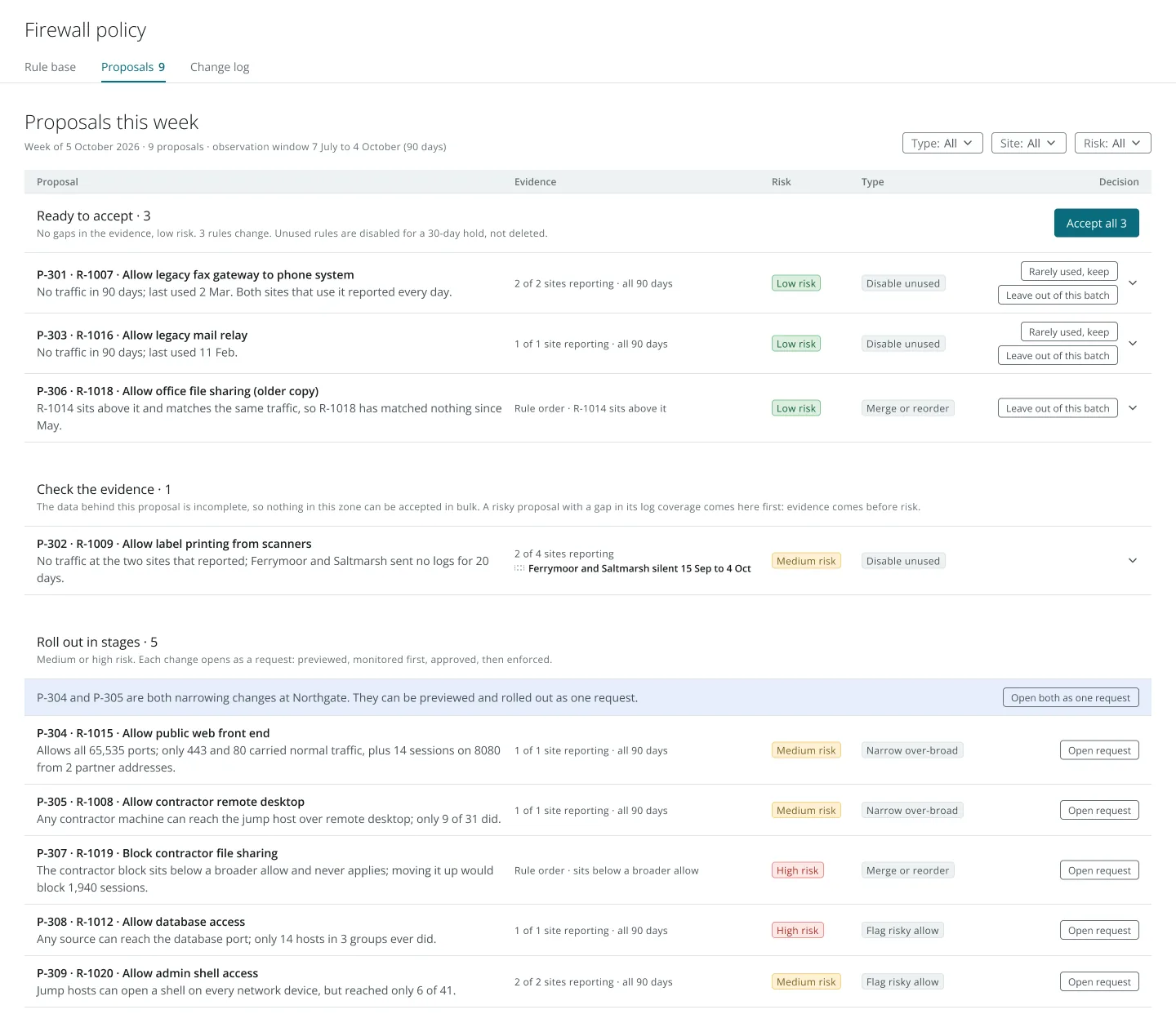
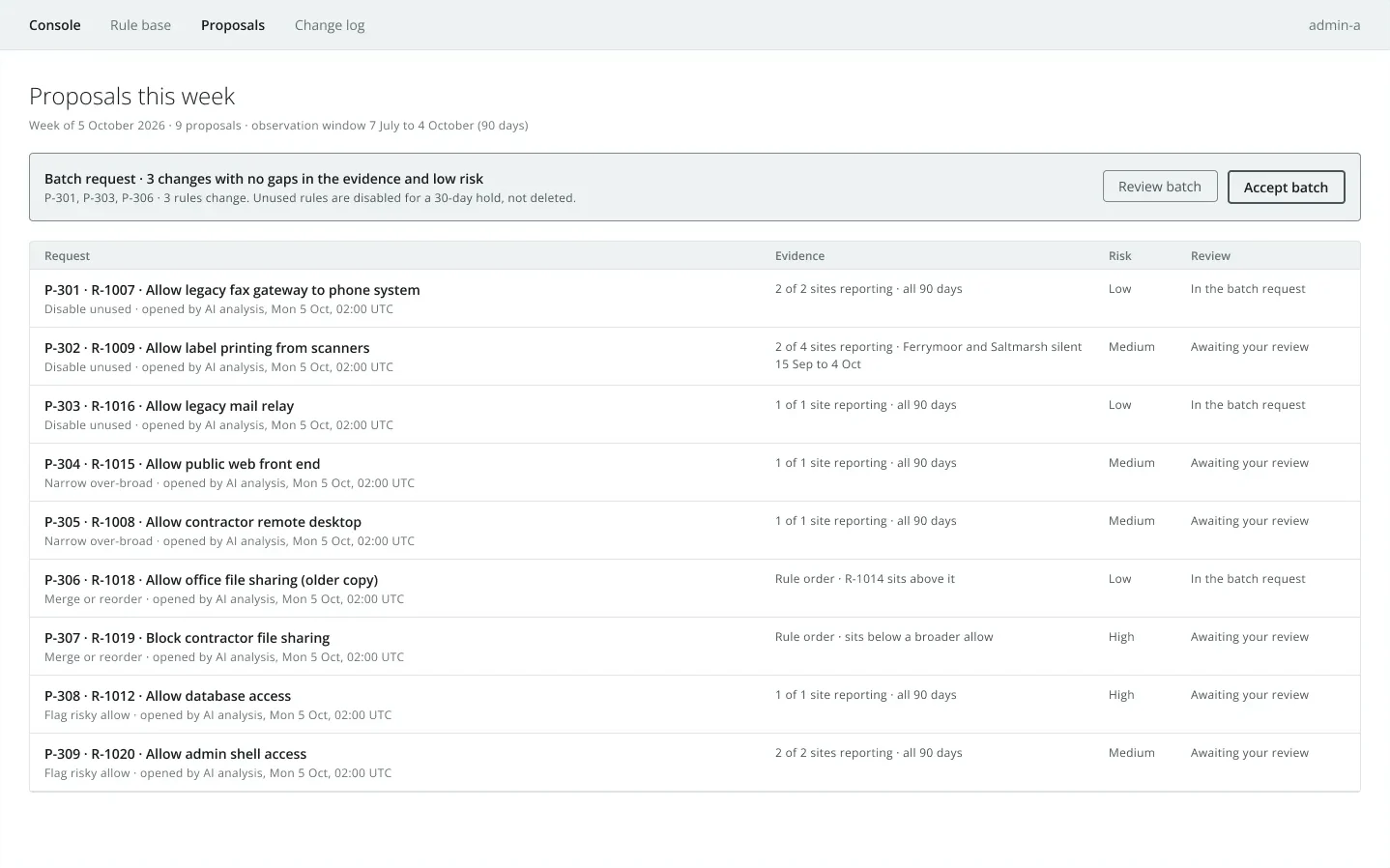
Safe changes are approved in one click, missing evidence is shown first, and risky changes roll out in stages.
- ASafe changes go together. Unused for 90 days with full logs: disabled for a 30-day hold, never deleted.
- BThe gap comes first. Two sites were silent for 20 days, so "no traffic" isn't evidence.
- CRisky changes roll out in stages. Each one opens as its own request.
Go deeper 1 min
The sample week
An invented company with four sites and 20 rules. Nine proposals arrive on Monday 5 October 2026, from a 90-day observation window: three ready to accept, one with a gap in its evidence, five medium or high risk.
Evidence before risk
A risky proposal with a gap in its log coverage goes to Check the evidence first. You can't judge the risk of a change while the data behind it is incomplete.
Edge states I drew
- An empty week, loading, and a week that failed to load, with Try again.
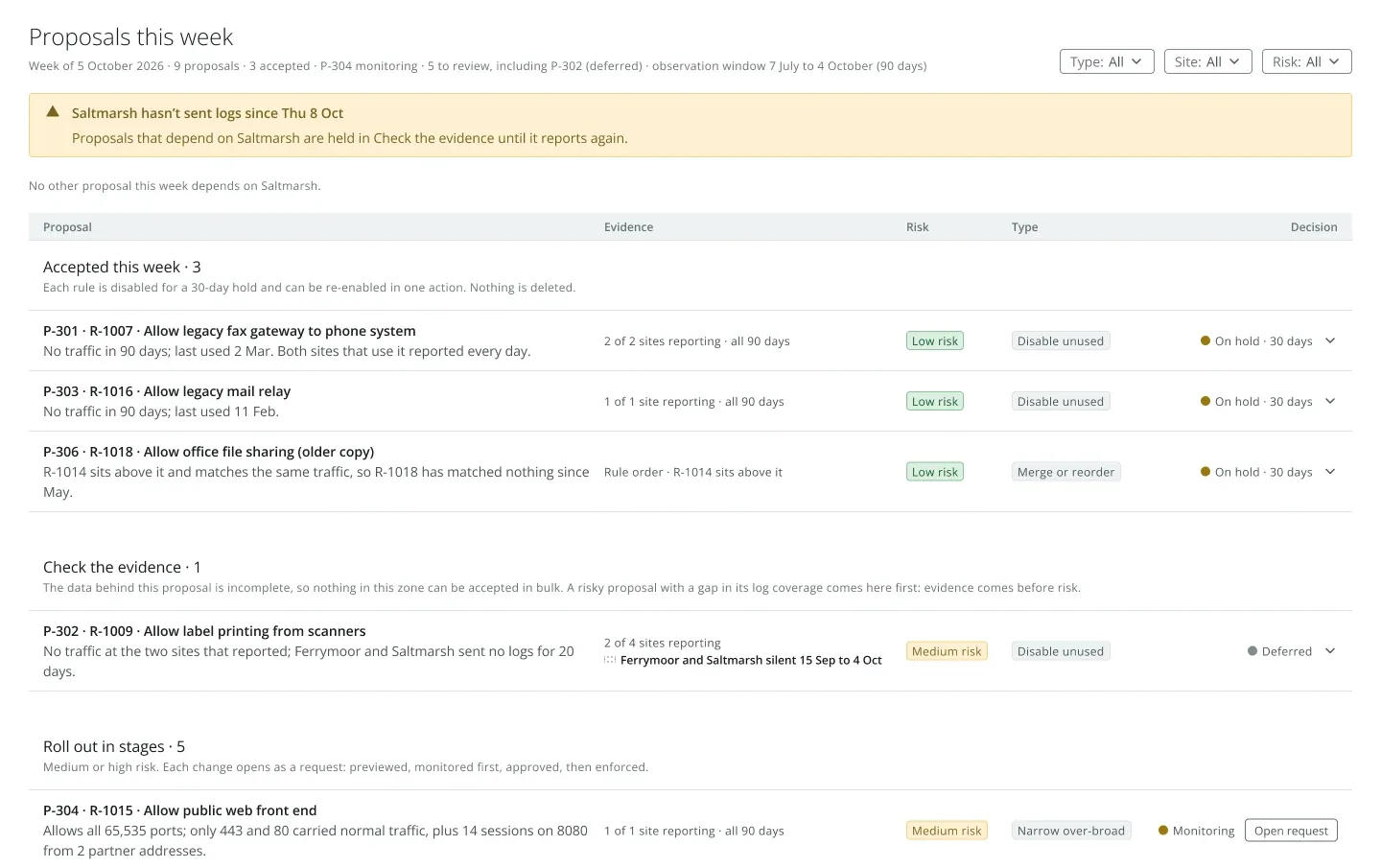
- A site that stops reporting: every proposal that depends on it is held, with a banner that says why.
- An admin without permission to enforce, who proposes the change to a change approver instead.
- An approver policy that sends every change for sign-off, previewed on the week before saving.
03The decision
Quick approval for safe changes. A separate page for risky ones.
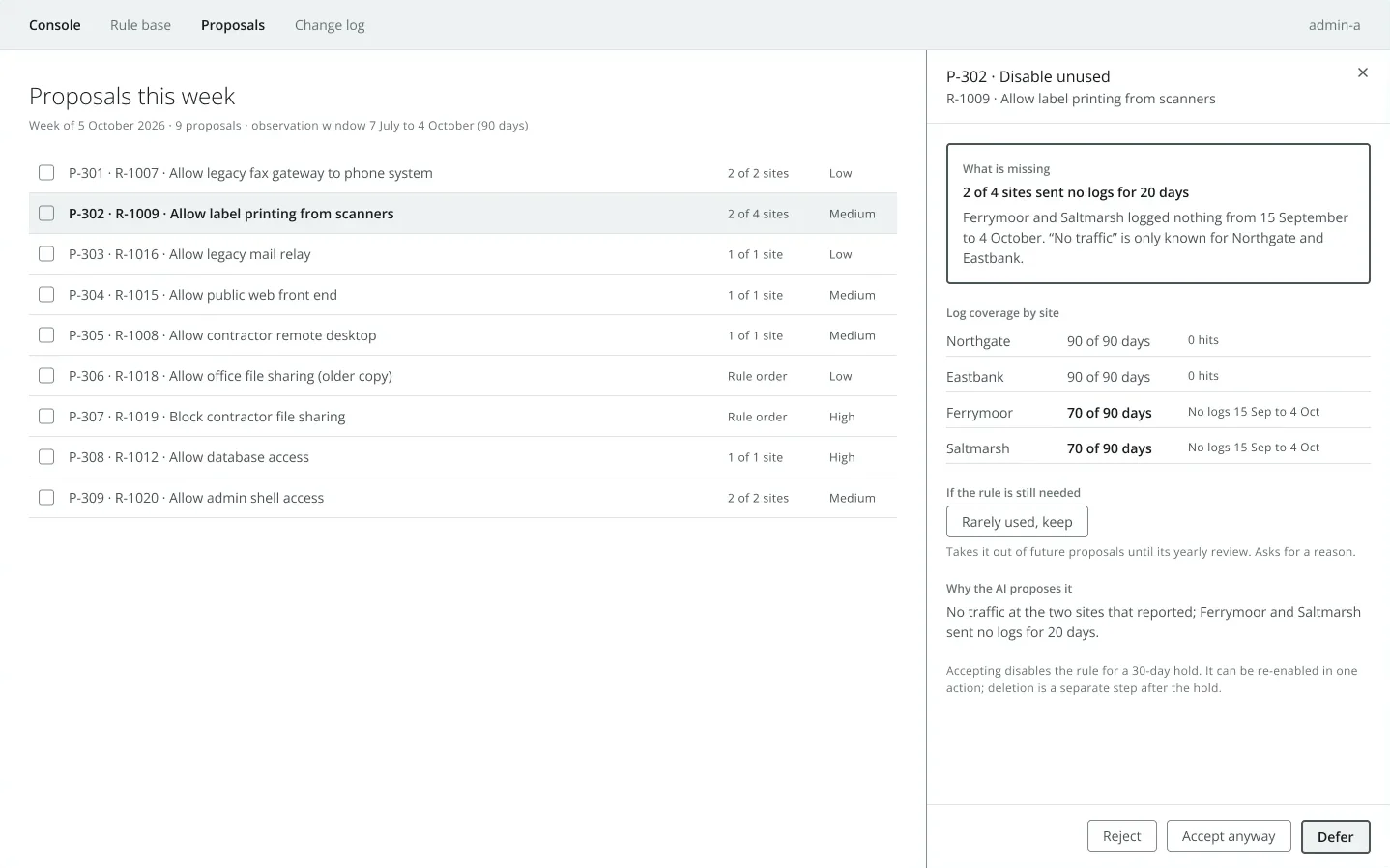
I compared six layouts on the same data. The final one combines the best two: groups for the week, and a page for each risky change.
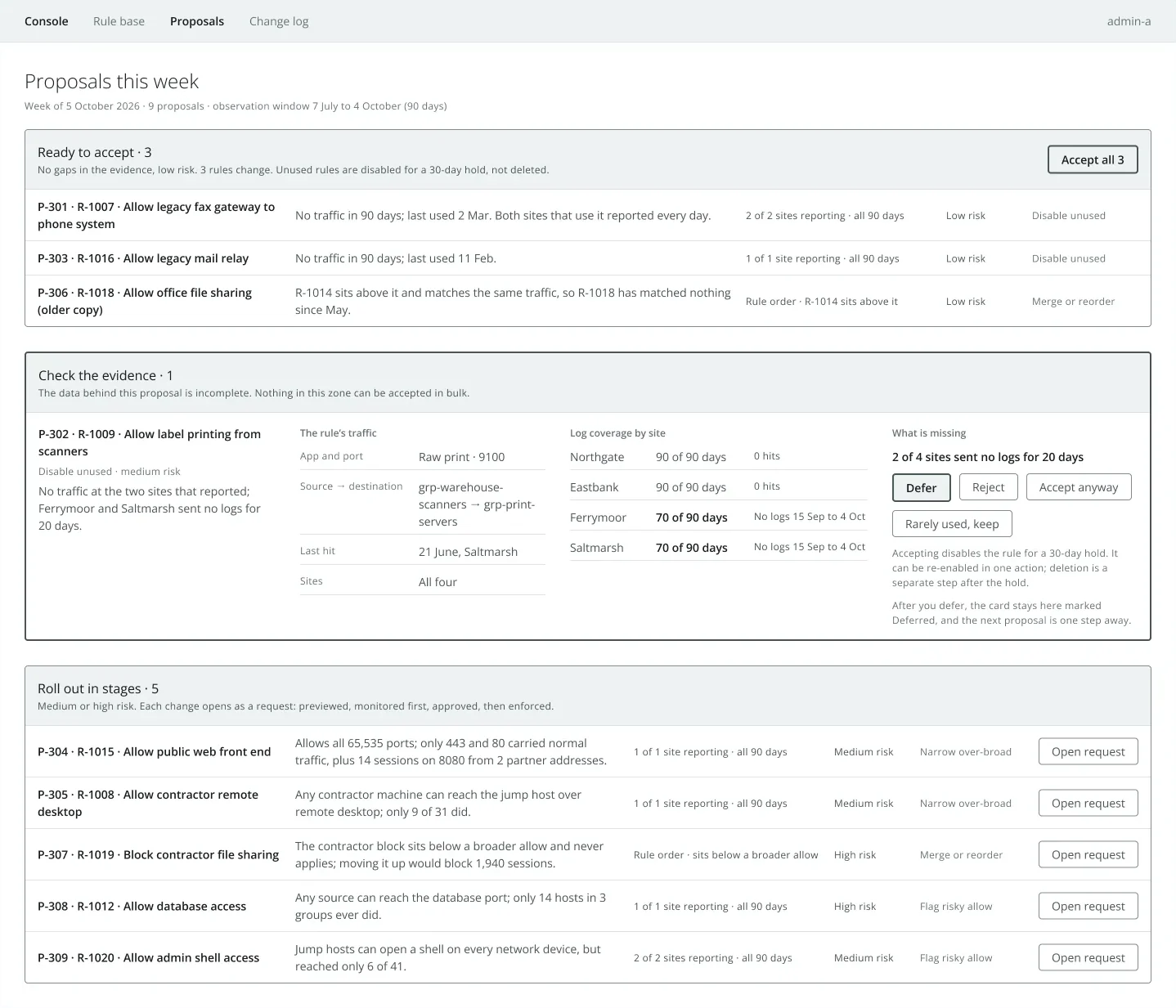
The trade. F asks for an approver only when a change can block traffic. Everything else is recorded with its reason in the change log.
Go deeper 2 min
Criteria first
Seven criteria grew from the questions in my brief; an evaluator agent weighted them and added an eighth, and I confirmed the set. The two that count three times: a coverage gap can't be missed before accepting, and what would stop working is on screen before any action that can block traffic.
Six directions
- A, list and side panel. Fast, but evidence, impact and the rule diff share 480 px.
- B, three zones. Sorted by the work; gave up grouping by type.
- C, one at a time. A heavy week of 90 proposals means 90 screens.
- D, pull request. Full review, but slow, with an approver on every change.
- E, inline in the rule base. No view of the week.
Too close to call, so I asked a question
AI evaluator agents scored A to E twice, one pass blind. B (73.0 of 90) and D (69.5) were under the 10% close-call gate, so no winner. I asked whether a combination could score higher. F came first in both passes of round three: 75.0 against D's 65.5 and B's 65.0. Confidence is medium: the blind pass was stricter, and in it F only ties D on the two heaviest criteria.
04Missing evidence
The admin sees missing evidence before any button.
Approving anyway is allowed, but they have to write down why.
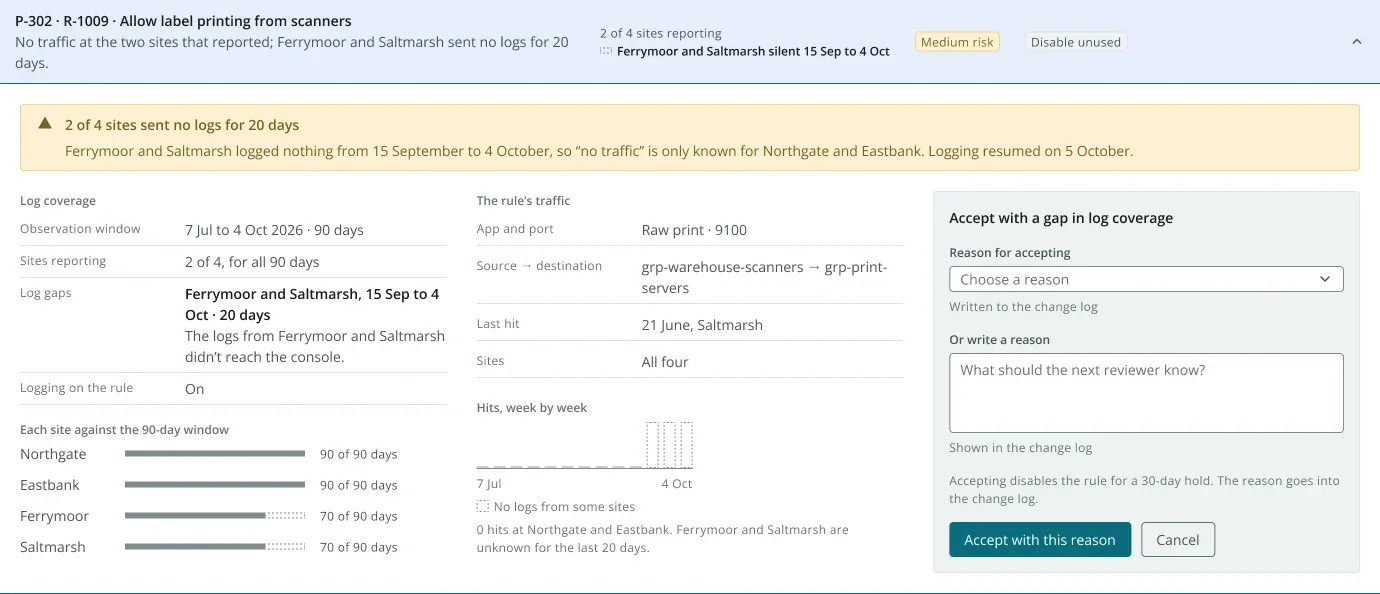
- AWhat's missing, in words. Above everything else on the card.
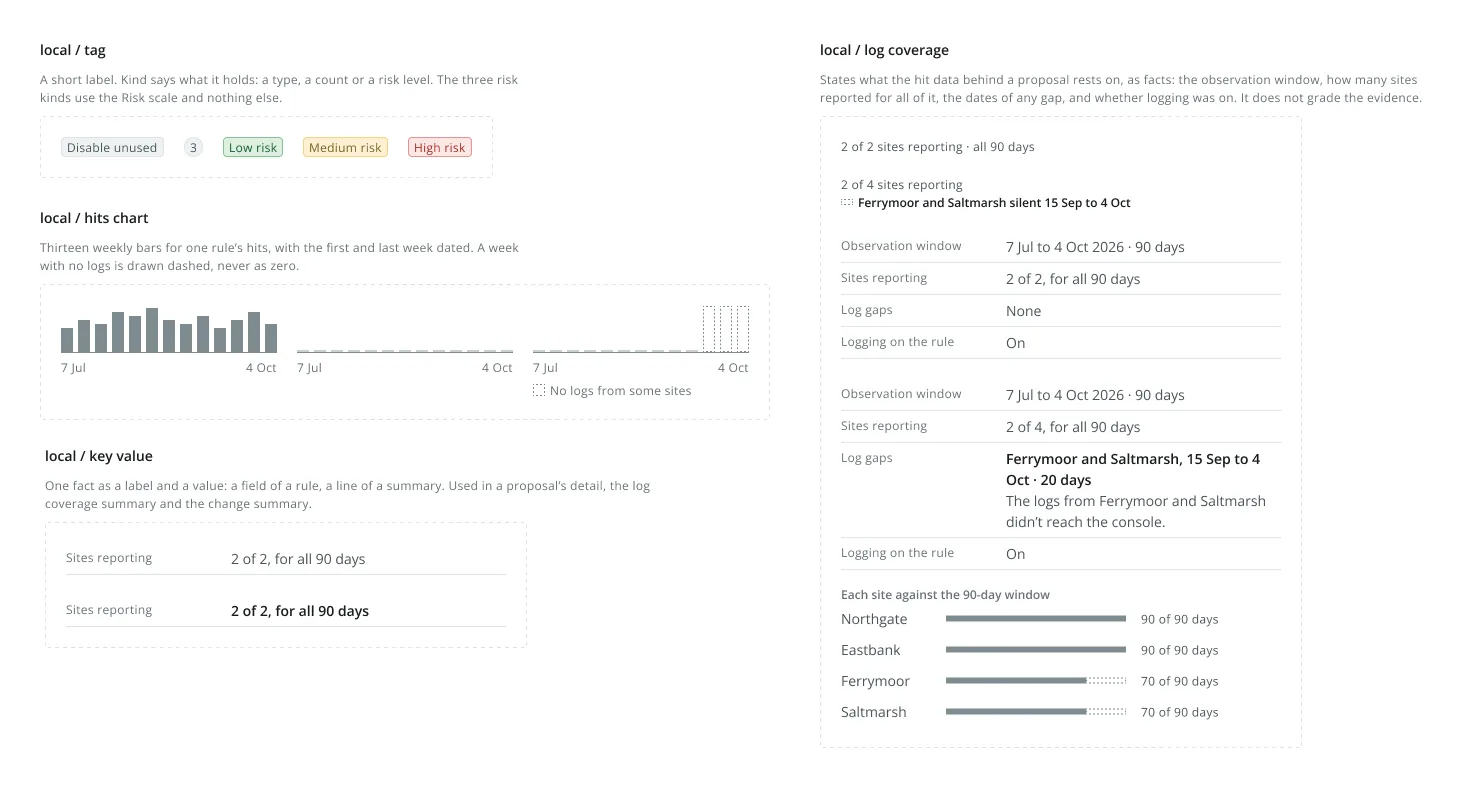
- BSilence shows as a gap, not as zero hits. Dashed in the site bars and in the weekly chart.
- CAccepting anyway is allowed. It asks for a reason, which goes into the change log.
Go deeper 1 min
The main path is to defer until the logs are complete.
Why a sentence, not a warning
Explanations made people more likely to accept AI advice whether or not it was right (Bansal et al., 2021). Designs that force a moment of thought reduced over-reliance more, though people rated them lowest (Buçinca et al., 2021). Both studies used general decision tasks, not security admins, so they support the concern, not a number.
What I threw out: an evidence-strength grade
A label such as strong or weak would be one more judgement stacked on the AI's own. The card states what was measured instead: the observation window, how many sites reported, the dates of any gap, and whether logging was on. The admin does the grading.
The target it serves
8 of 10 admins notice a planted gap in the logs before accepting. A target set before drawing, not measured.
05The request
A change that could block traffic gets a preview, a reviewer and an undo.
The system suggests, a person decides, and the screen shows the impact before anything is blocked.
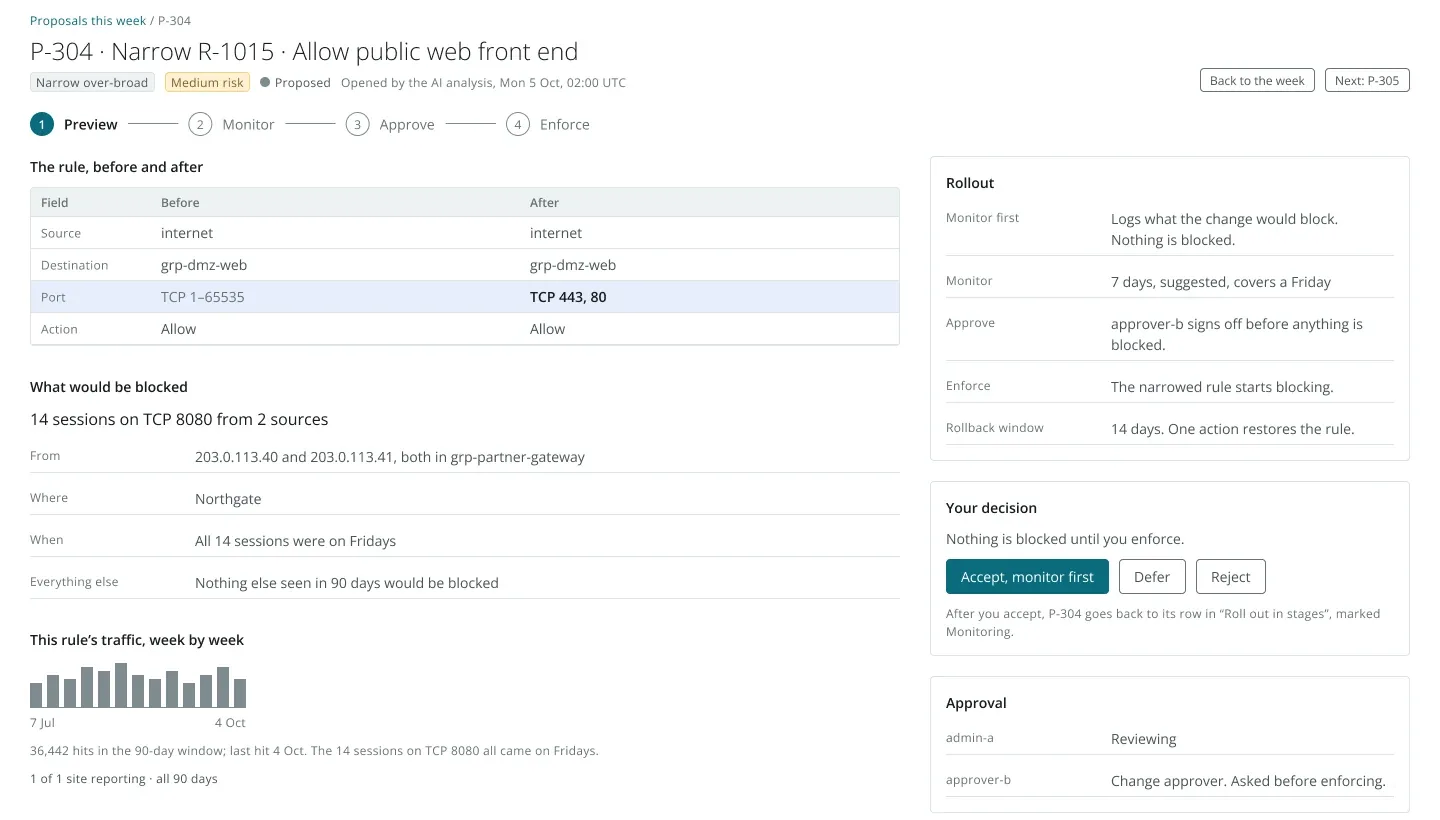
- APreview, monitor, approve, enforce. Nothing is blocked until the last step.
- BThe rule, before and after. All ports narrowed to 443 and 80.
- CWhat would break, in words. 14 partner sessions on 8080, all on Fridays.
- DThe monitor fits the evidence. Seven days, so it covers a Friday.
Go deeper 1 min
Where the request page came from
From option D: the preview, the staged rollout, the approval and the audit trail live on one page that outlives the week. From the scoring fixes: the rollout plan suggests a monitor that matches the rule's traffic pattern, and the page says where the admin lands after each decision.
Who signs off
A change approver is asked only before enforcing. An admin without permission to enforce sends the change to the approver with a reason, and the approver's view shows what the monitor saw, including whether it covered a Friday.
06Being wrong
A wrong approval can be undone before it causes an outage.
The admin can overrule the suggestion, and the override is visible and easy to undo.
The same change, down two paths
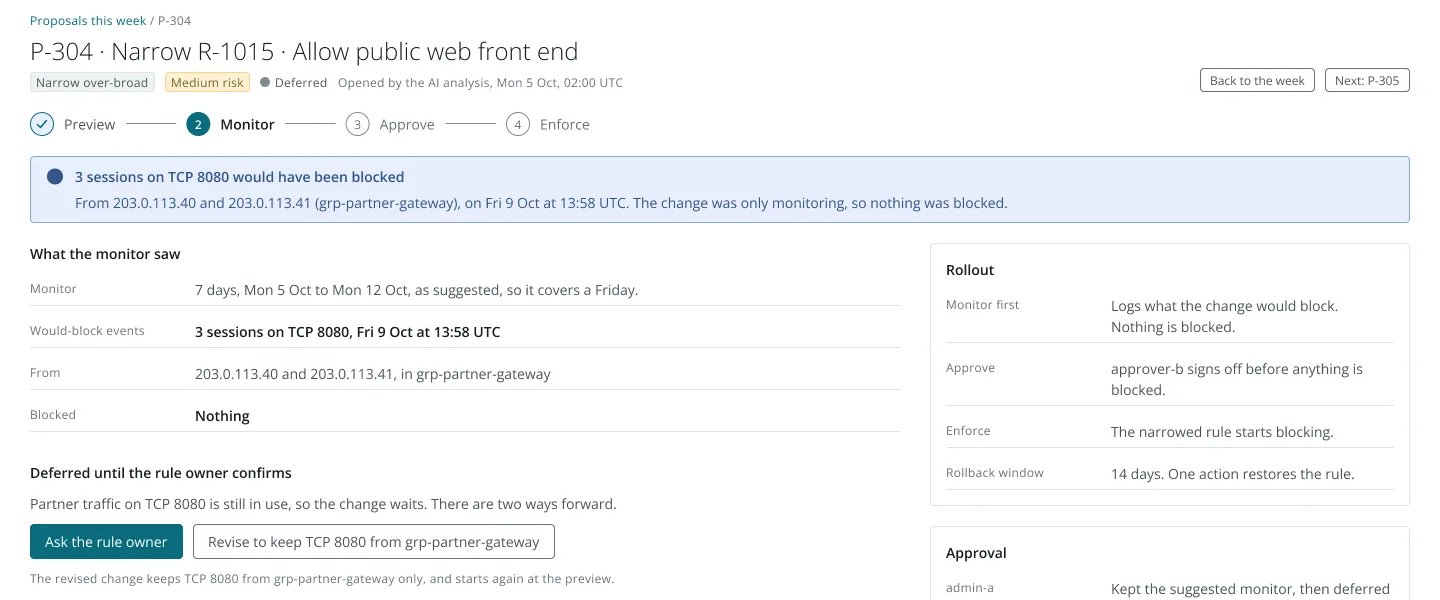
- 1The monitor catches Friday. Three partner sessions would have been blocked. Nothing was.
- 2The change waits for the rule owner. Or it's revised to keep the partner's port open.
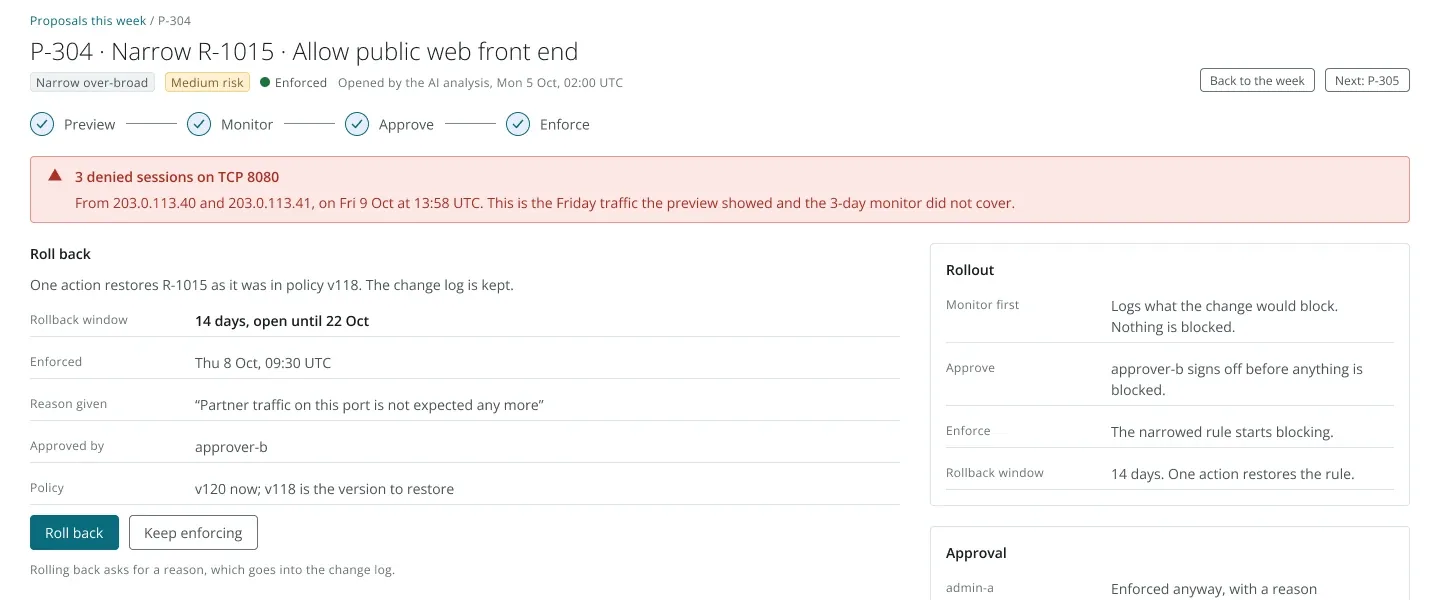
- 1What went wrong, in words. The Friday traffic the shortened monitor didn't cover.
- 2The way back is still open. 14 days, with who approved what, and why.
- 3One action restores the rule. Rolling back asks for a reason too.
Prevention first, recovery second. The suggestion and the warning are there to stop the outage; the rollback is there for when they're overruled.
Go deeper 1 min
- 1PreviewWhat would be blocked, for whom, and when.
- 2MonitorLogs what the change would block. Nothing is blocked.
- 3ApproveA change approver signs off.
- 4EnforceThe narrowed rule starts blocking.
- 5Roll backOne action restores the rule, for 14 days.
Why two paths
The first version told one story: a 3-day monitor missed the Friday traffic and the change was enforced. A cold read found it undercut the design, as if the failure were the main path. So the prototype follows both: the suggested monitor kept, and the override with its way back.
Two windows, on purpose
- A disabled rule is held for 30 days and can be switched back at any time. Nothing is deleted.
- A narrowed rule can be restored in one action for 14 days, to the policy version before it. The 14 days is my choice.
The target it serves
0 of 5 seeded cases where an accepted change blocks traffic the admin didn't expect. A target set before drawing, not measured.
07How it was made
I set the problem, the goals and the decisions. AI drew the screens from my brief.
The goals came first: three targets, written down before any drawing. None has been measured yet.
to clear a typical week's safe changes
Target · not measuredadmins notice a planted gap in the logs before accepting
Target · not measuredseeded cases where an accepted change blocks unexpected traffic
Target · not measuredTargets, not findings. Public research supports the concerns behind them, not the numbers. Nothing has been tested with admins yet; that's the next step.
Who did what
Go deeper 1 min
Built on Vela
The only library enabled is Vela, my public design system. Every colour, text style, radius and gap is bound to a Vela variable. Where Vela had no component, the part was built from its variables only, named local, and written up as a request to the design system rather than borrowed from another kit.
What I threw out
- Options A to E. They stay in the file with their scores, so the choice can be checked.
- The evidence-strength scale.
- The side panel: the first pick opened a proposal beside the list.
- The first P-304 story, which became two paths.
What's in the file
Problem and flow, explorations and scores, screens, states and edge cases, a wired prototype, handoff notes with the assumptions to test and accessibility notes, components, and the AI log.